

she takes space – Installation in public space
Christa Stöffelbauer, Mami Kawabata, Sylvia Bruckner, Xenia Rubin & Almut Rink
“ENG below”
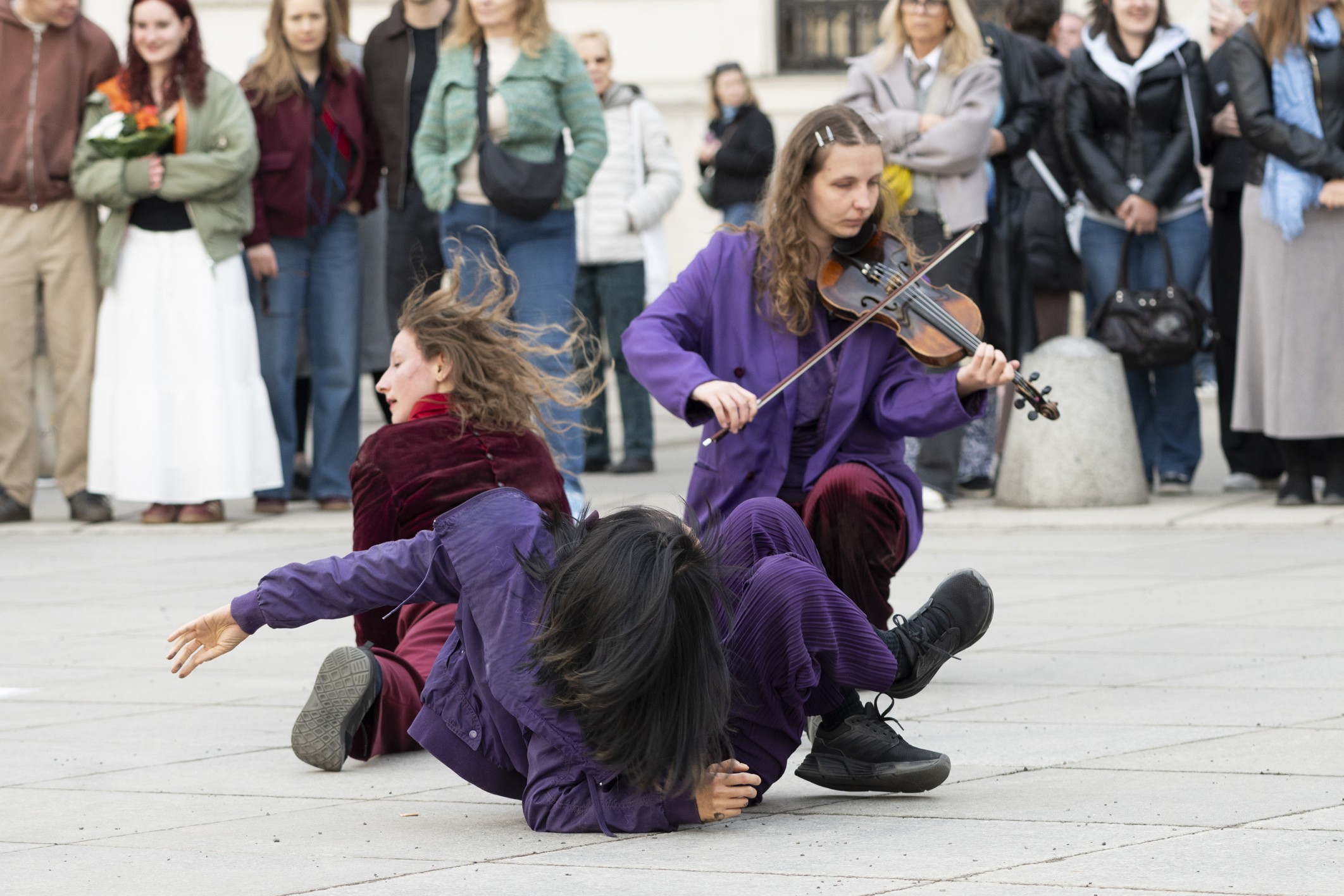
s h e t a k e s s p a c e ist eine offen zugängliche künstlerische Installation im öffentlichen Raum. Anlässlich des Internationalen Frauen*Theaterfestivals gestalten fünf Künstlerinnen aus den Bereichen Tanz, Live- Musik und Bildender Kunst einen lebendigen Raum des Miteinanders und setzen ein weibliches Statement für Respekt und gleichberechtigte Teilhabe. Die interdisziplinäre Arbeit stellt Fragen zu Machtverhältnissen in unserer Gesellschaft, indem sie individuelle und kollektive Erfahrungen von Frauen anerkennt, reflektiert und zum bewussten Einnehmen, Gestalten und Verändern von Räumen und zu solidarischem Handeln ermutigt. Klänge bewegen Körper, Farben antworten auf Gesten – ein offener & poetischer Dialog auf Augenhöhe. Die Künstlerinnen machen dadurch Solidarität spürbar: gemeinsam gestalten – für gleiche Teilhabe, Toleranz, Inklusion, Selbstbestimmung und ein respektvolles Zusammenleben. Abschließend sind alle Anwesenden eingeladen mitzutanzen.
Ort: Hauptwache vor der Katherinenkirche
Sprache: non-verbal
Konzept, Künstlerische Leitung: Christa Stöffelbauer
Performance: Mami Kawabata, Sylvia Bruckner, Xenia Rubin, Almut Rink, Christa Stöffelbauer
Instagram: @christa.stoeffelbauer @kawabatamami @bruckner.sylvia @xenia.rbn
Website: https://www.xeniarubin.com https://www.almutrink.net https://www.sylviabruckner.com
©Foto Credit: Laurent Ziegler
Biographie: Die in Wien lebenden Künstlerinnen – Christa Stöffelbauer, Mami Kawabata, Sylvia Bruckner, Xenia Rubin und Almut Rink – teilen das Interesse und die Neugierde, durch die Interaktion von Tanz, Live-Musik und bildender Kunst, Räume für neue Begegnungen zu schaffen. Im Spannungsfeld zwischen Individuum und Kollektiv liegt ihr Fokus auf dem Potenzial der gemeinsamen Komposition im Moment, in Beziehung zu Zeit, Raum und Publikum. Durch ihre künstlerische Zusammenarbeit möchten sie den öffentlichen Raum aktivieren, ihn als gemeinsamen Lebensraum, der sich in ständigem Wandel befindet, zurückerobern, in dem alle zur Gestaltung beitragen dürfen und so Perspektiven der Mitgestaltung im städtischen Raum und in den eigenen Beziehungen eröffnen.
s h e t a k e s s p a c e – Installation in public space
s h e t a k e s s p a c e is an open-access art installation in a public space. In the frame of International Women’s* Theater Festival, five female artists, working in the fields of dance, music and fine arts are creating a lively space for respectful encounters, setting a female statement for respect and equal participation. The interdisciplinary work raises questions about power relations in our society by acknowledging and reflecting on individual and collective experiences of women, encouraging to consciously take, create and change spaces and to act in solidarity. Sounds move bodies, colours respond to gestures – an open & poetic dialogue on eye-level. The artists create a tangible sense of solidarity: co-creating for equal participation, tolerance, self-determination and respectful coexistence. At the end, the audience is invited to join the dance.
Location: Hauptwache in front of Katherinenkirche
Language: non-verbal
Concept, Director: Christa Stöffelbauer
Performance: Mami Kawabata, Sylvia Bruckner, Xenia Rubin, Almut Rink, Christa Stöffelbauer
Instagram: @christa.stoeffelbauer @kawabatamami @bruckner.sylvia @xenia.rbn
Website: https://www.xeniarubin.com https://www.almutrink.net https://www.sylviabruckner.com
©Foto Credit: Laurent Ziegler
Biography: The Vienna-based artists – Christa Stöffelbauer, Mami Kawabata, Sylvia Bruckner, Xenia Rubin and Almut Rink – share an interest and curiosity in creating spaces for new encounters through the interplay of dance, live music and visual art. In the field of tension between individual and the collective, their focus lies on the potential of collaborative composition in the moment, in relation to time, space and the audience. Through their artistic collaboration, they aim to activate public space, reclaiming it as a shared living space that is in constant change, where everyone is allowed to contribute, thereby opening up perspectives on co-creation within the urban environment and in one’s own relationships.